Finite-state Markov chain
Definition taught in Markov chains, part of Probability
Finite-state Markov chain
| Type | Definition |
| Taught in | Markov chains |
| Part | Probability |
| Properties | 1 |
| Worked examples | 3 |
| Questions using it | 4 |
Let E be a finite set of states and let X_0,X_1,X_2,\ldots take values in E. The process is a Markov chain when, for every n and every choice of states,
\mathbb{P}(X_{n+1}=j\mid X_n=i, X_{n-1}=i_{n-1},\ldots,X_0=i_0)=\mathbb{P}(X_{n+1}=j\mid X_n=i).
It is time-homogeneous when the right-hand side does not depend on n. The transition matrix P then has entries P_{ij}=\mathbb{P}(X_{n+1}=j\mid X_n=i).
Properties
Limiting distribution
Main article: Limiting distribution
Suppose P is the transition matrix of an irreducible aperiodic chain on a finite set. Then there is a unique probability row vector \boldsymbol\pi with \boldsymbol\pi=\boldsymbol\pi P, and for every start i and every state j,
\lim_{n\to\infty}(P^n)_{ij}=\pi_j.
Every row of P^n converges to \boldsymbol\pi. The equations \boldsymbol\pi=\boldsymbol\pi P together with \sum_j \pi_j=1 determine \boldsymbol\pi.
Examples
Six stepping stones
Worked example from Markov chains
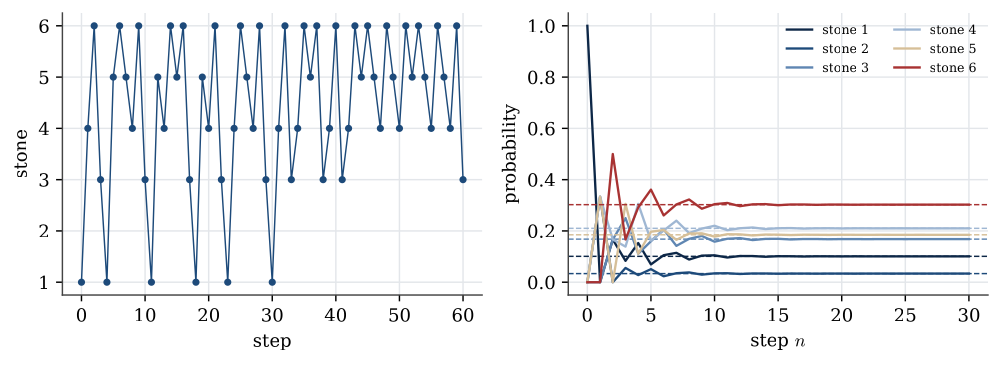
A frog hops between six stepping stones. From each stone it jumps to one of the stones joined to it, choosing uniformly among them, except that from stone 4 it always goes to stone 6. The transition matrix, with rows and columns in the order of the stones, is
P=\begin{pmatrix} 0&1/3&0&1/3&1/3&0\\ 1/2&0&1/2&0&0&0\\ 1/2&0&0&1/2&0&0\\ 0&0&0&0&0&1\\ 0&0&0&1/2&0&1/2\\ 0&0&1/2&0&1/2&0 \end{pmatrix}.
Question. Starting on stone 1, find the distribution after two steps, and the long-run proportion of time spent on each stone.
Solution. The distribution after two steps is the first row of P^2:
(1/6,\ 0,\ 1/6,\ 1/6,\ 0,\ 1/2).
For example, stone 6 is reached in two steps through stone 4 or stone 5, with probability \tfrac13\cdot1+\tfrac13\cdot\tfrac12=\tfrac12. Stones 2 and 5 cannot be reached from stone 1 in exactly two steps. After ten steps the probability of being back on stone 1 is 0.1049, and by n=100 every row of P^n agrees to four decimal places.
The chain is irreducible, and it is aperiodic because it can return to stone 1 in both 2 and 3 steps, which have greatest common divisor 1. Solving \boldsymbol\pi=\boldsymbol\pi P with \sum_j\pi_j=1 gives
\boldsymbol\pi=\frac1{119}(12,\ 4,\ 20,\ 25,\ 22,\ 36)=(0.101,\ 0.034,\ 0.168,\ 0.210,\ 0.185,\ 0.303).
The first equation, \pi_2=\pi_1/3, says that stone 2 is entered only from stone 1, a third of the time. In the long run the frog spends 30% of its time on stone 6 and only 3% on stone 2, whichever stone it started from.
Two steps of a three-state chain
Question page: Two steps of a three-state chain
A chain on \{1,2,3\} has transition matrix
P=\begin{pmatrix}0.5&0.5&0\\0.25&0.5&0.25\\0&0.5&0.5\end{pmatrix}.
Starting from state 1, find the distribution of X_2, and the probability that X_1=2 and X_2=3.
The distribution of X_2 is the first row of P^2:
(0.5\times0.5+0.5\times0.25,\ 0.5\times0.5+0.5\times0.5,\ 0.5\times0.25)=(0.375,\ 0.5,\ 0.125).
The path 1\to2\to3 has probability P_{12}P_{23}=0.5\times0.25=0.125. It is the only two-step path from 1 to 3, which is why it equals \mathbb{P}(X_2=3).
Where a random walk can be
Question page: Where a random walk can be
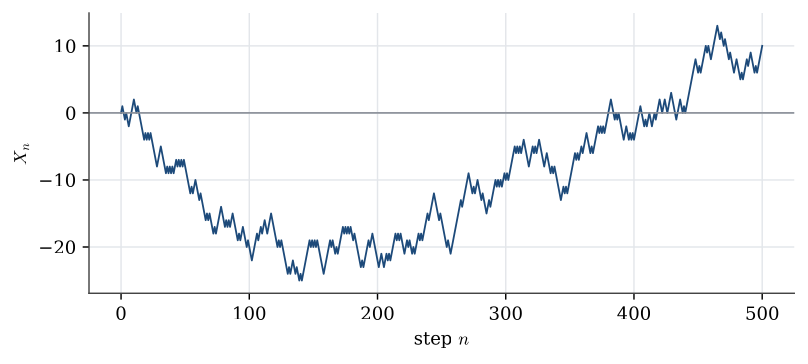
A random walk on the integers starts at 0 and steps +1 with probability p and -1 with probability q=1-p. Find \mathbb{P}(X_n=k). Why is \mathbb{P}(X_n=0)=0 when n is odd?
Let K\sim\operatorname{Bin}(n,p) be the number of steps up. Then X_n=K-(n-K)=2K-n, so X_n=k exactly when K=(n+k)/2:
\mathbb{P}(X_n=k)=\binom{n}{(n+k)/2}p^{(n+k)/2}q^{(n-k)/2},
for |k|\le n with n+k even, and 0 otherwise. X_n=2K-n has the same parity as n, so an odd number of steps can never end at 0.
Figures
Used in
- Taught in Markov chains, where the derivation and examples are.
- Also used in Galton–Watson branching · Discrete-time Markov chains · Classes, recurrence, and reversibility · Continuous-time Markov chains · Markov chains, Gibbs sampling, and Metropolis–Hastings
- Questions that use it (4) — Two steps of a three-state chain · The limit of the three-state chain · A doubly stochastic matrix · One closed class (answer)
- All 6 questions on Markov chains
See also
Detailed balance · Discrete-time Markov chain · Generator · Limiting distribution