Marginal model
Definition taught in Marginal models, and two responses at once, part of Correlated data
Marginal model
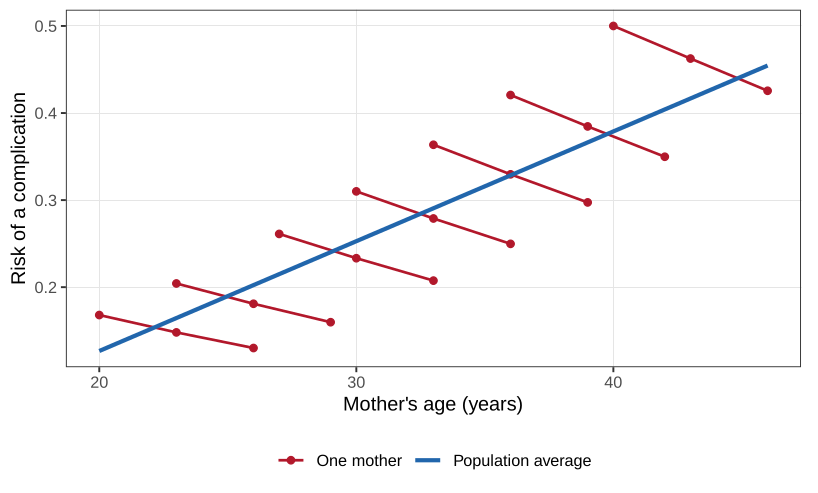
| Type | Definition |
| Taught in | Marginal models, and two responses at once |
| Part | Correlated data |
| Worked examples | 2 |
| Questions using it | 5 |
A marginal model for clustered responses has three parts.
Definition
- A mean, g(\mathrm{E}(Y_{ji}\mid {\boldsymbol{X}}_{ji}))={\boldsymbol{X}}_{ji}^\top\boldsymbol{\beta}, the same link and the same linear predictor as for independent data.
- A variance, \mathrm{Var}(Y_{ji}\mid {\boldsymbol{X}}_{ji})=\phi V(\mu_{ji}), depending on the covariates only through the mean.
- A working association within a cluster, allowed to depend on the two means and on further association parameters.
Examples
C38. Generalised estimating equations
Question page: C38. Generalised estimating equations
What are generalised estimating equations, and what mean-model parameters do they estimate?
Definitions/notation. GEE are estimating equations for the coefficients of a marginal (population-average) mean model for correlated responses, constructed using derivatives of the mean and a working within-cluster covariance. They require no full joint response distribution, but assume independent clusters and, for consistency under standard regularity conditions, a correctly specified marginal mean.
C40. Sandwich robustness
Question page: C40. Sandwich robustness
What misspecification can the GEE sandwich covariance estimator tolerate? Does it repair an incorrect mean model?
Definitions/notation. The sandwich estimator estimates the sampling covariance of the GEE coefficient estimator using empirical cluster residual variation, allowing the working covariance to be misspecified. It does not repair an incorrect mean model: its usual robustness is asymptotic with many independent clusters, a correct marginal mean, valid estimating equations and regularity conditions, not a guarantee for small samples or informative missingness.
Figures
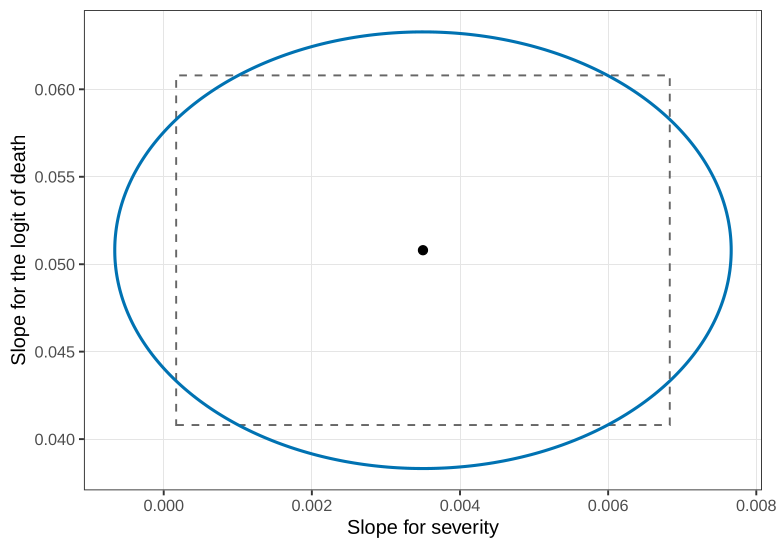
Used in
- Taught in Marginal models, and two responses at once, where the derivation and examples are.
- Also used in Random slopes, and a binary mixed model · Three species on one hillside
- Questions that use it (5) — Question 20 (answer) · C38 · C39 · C40 · C41
- All 6 questions on Marginal models, and two responses at once