Covariance
Definition taught in Joint distributions, part of Probability
Covariance
| Type | Definition |
| Taught in | Joint distributions |
| Part | Probability |
| Properties | 1 |
| Worked examples | 2 |
| Questions using it | 1 |
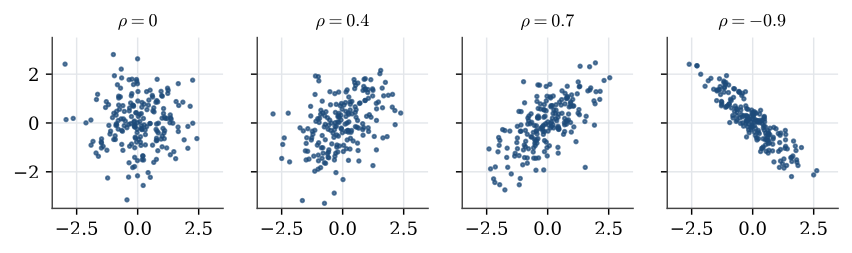
The covariance of X and Y is \operatorname{Cov}(X,Y)=\mathbb{E}\bigl((X-\mathbb{E} X)(Y-\mathbb{E} Y)\bigr), when the expectation exists. Equivalently, \operatorname{Cov}(X,Y)=\mathbb{E}(XY)-(\mathbb{E} X)(\mathbb{E} Y).
Properties
Affine images of normal vectors
Main article: Affine images of normal vectors
If X_i\sim\operatorname{N}(\mu_i,\sigma_i^2) are independent and a,b_1,\ldots,b_n are constants, then
a+\sum_{i=1}^n b_i X_i \sim \operatorname{N}\Bigl(a+\sum_{i=1}^n b_i\mu_i,\;\sum_{i=1}^n b_i^2\sigma_i^2\Bigr).
The same conclusion holds for a jointly normal vector and any affine image, with the output variance \mathbf{b}^\top\Sigma\mathbf{b}.
Examples
Signs and their sum
Question page: Signs and their sum
Let U and V be independent, with \mathbb{P}(U=1)=\mathbb{P}(V=1)=1/4 and \mathbb{P}(U=-1)=\mathbb{P}(V=-1)=3/4. Set X=U/V and Y=U+V.
Give the joint probability mass function of (X,Y).
Calculate \operatorname{Cov}(X,Y).
- Since V=\pm1, 1/V=V and X=UV. The four sign pairs give
| (U,V) | Probability | X | Y |
|---|---|---|---|
| (1,1) | 1/16 | 1 | 2 |
| (1,-1) | 3/16 | -1 | 0 |
| (-1,1) | 3/16 | -1 | 0 |
| (-1,-1) | 9/16 | 1 | -2 |
so \mathbb{P}(X=1,Y=2)=1/16, \mathbb{P}(X=-1,Y=0)=6/16 and \mathbb{P}(X=1,Y=-2)=9/16.
- \mathbb{E} X=10/16-6/16=1/4, \mathbb{E} Y=\mathbb{E} U+\mathbb{E} V=2(1/4-3/4)=-1 and \mathbb{E}(XY)=2\times1/16-2\times9/16=-1. So
\operatorname{Cov}(X,Y)=-1-\tfrac14\times(-1)=-\tfrac34.
Used in
- Taught in Joint distributions, where the derivation and examples are.
- Also used in Functions of random variables and limit theorems
- Questions that use it (1) — A product density (answer)
- All 8 questions on Joint distributions
See also
Expectation · Expectation vector and covariance matrix · Multivariate normal distribution · Joint probability mass function · Independent random variables · Joint probability density · Conditional distribution · Tower property