Multivariate normal distribution
Definition taught in Functions of random variables and limit theorems, part of Probability
Multivariate normal distribution
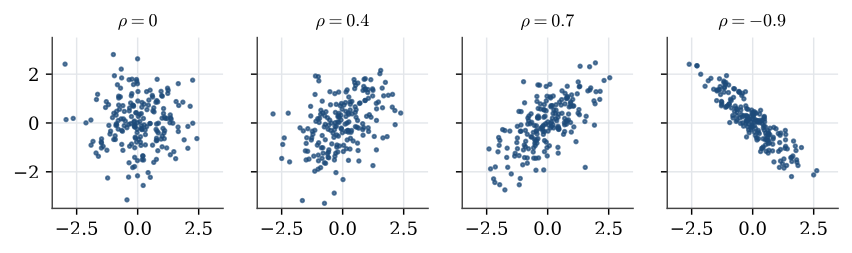
| Type | Definition |
| Taught in | Functions of random variables and limit theorems |
| Part | Probability |
| Properties | 1 |
| Questions using it | 5 |
A random vector \mathbf{Z} in \mathbb{R}^n is multivariate normal with mean \boldsymbol\mu and covariance matrix \Sigma, when \Sigma is positive definite and the density is
f(\mathbf{z})=(2\pi)^{-n/2}\,|\Sigma|^{-1/2}\,\exp\Bigl(-\tfrac12(\mathbf{z}-\boldsymbol\mu)^\top\Sigma^{-1}(\mathbf{z}-\boldsymbol\mu)\Bigr).
If \mathbf{X} has independent standard normal coordinates and \Sigma=BB^\top, then \boldsymbol\mu+B\mathbf{X} has this distribution. The representation is the definition used when \Sigma is only positive semidefinite and no density exists.
Properties
Affine images of normal vectors
Main article: Affine images of normal vectors
If X_i\sim\operatorname{N}(\mu_i,\sigma_i^2) are independent and a,b_1,\ldots,b_n are constants, then
a+\sum_{i=1}^n b_i X_i \sim \operatorname{N}\Bigl(a+\sum_{i=1}^n b_i\mu_i,\;\sum_{i=1}^n b_i^2\sigma_i^2\Bigr).
The same conclusion holds for a jointly normal vector and any affine image, with the output variance \mathbf{b}^\top\Sigma\mathbf{b}.
Used in
- Taught in Functions of random variables and limit theorems, where the derivation and examples are.
- Also used in Joint distributions · Linear regression · Bayesian linear regression · Random slopes, and a binary mixed model · Dependence along a series
- Questions that use it (5) — The correlation test is the slope test (answer) · A bivariate-normal Gibbs sampler · Random-walk Metropolis for a correlated normal (answer) · Q52 (answer) · C34 (answer)
- All 21 questions on Functions of random variables and limit theorems
See also
Covariance · Affine images of normal vectors · Transformation rule · Normal linear model · Law of large numbers · Central limit theorem