Central limit theorem
Theorem taught in Functions of random variables and limit theorems, part of Probability
Central limit theorem
| Type | Theorem |
| Taught in | Functions of random variables and limit theorems |
| Part | Probability |
| Worked examples | 4 |
| Questions using it | 4 |
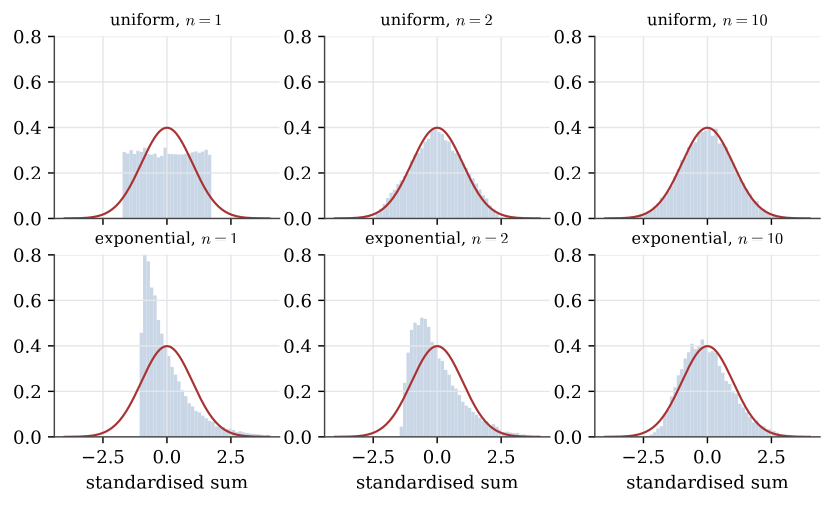
If the X_i are independent and identically distributed with mean \mu and variance \sigma^2\in(0,\infty), then for every x
\lim_{n\to\infty}\mathbb{P}\Bigl(\frac{S_n-n\mu}{\sigma\sqrt{n}}\le x\Bigr)=\Phi(x),
where \Phi is the standard normal distribution function.
Examples
Normal approximation to a binomial
Worked example from Functions of random variables and limit theorems
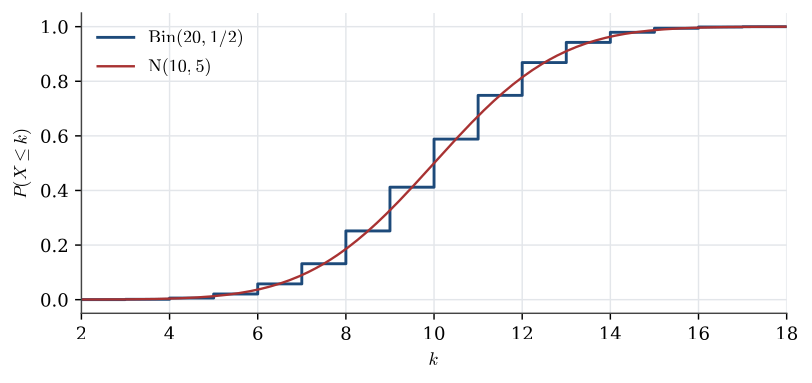
Let X\sim\operatorname{Bin}(20,1/2).
Question. Approximate \mathbb{P}(X\le8) by the central limit theorem, with and without a continuity correction, and compare with the exact value.
Solution. Here np=10 and np(1-p)=5. The exact probability is 0.2517. The plain approximation gives
\mathbb{P}(X\le8)\approx\Phi\Bigl(\frac{8-10}{\sqrt5}\Bigr)=\Phi(-0.894)=0.186,
which is poor. X is integer-valued, so \mathbb{P}(X\le8)=\mathbb{P}(X\le8.5), and the normal curve should be read at the midpoint between 8 and 9:
\mathbb{P}(X\le8)\approx\Phi\Bigl(\frac{8.5-10}{\sqrt5}\Bigr)=\Phi(-0.671)=0.251,
almost exact. A usual rule of thumb asks for both np and n(1-p) to be above 5.
A normal approximation in the tail
Question page: A normal approximation in the tail
Let X\sim\operatorname{Bin}(100,1/2). Approximate \mathbb{P}(X\ge 60) by a normal probability. Use \Phi(2)\approx 0.97725.
The approximating normal has mean 50 and variance 25.
\mathbb{P}(Y\ge 60)=\mathbb{P}\bigl(Z\ge (60-50)/5\bigr)=\mathbb{P}(Z\ge 2)=1-\Phi(2)\approx 0.0228.
A sieve for blueberries
Question page: A sieve for blueberries
Blueberry diameters are \operatorname{N}(1, 0.1^2), in centimetres. A sieve of diameter d classifies a berry as large when its diameter exceeds d.
Choose d so that 30% of berries are large. Use the standard normal quantile z_{0.7}\approx 0.524, that is the point with \Phi(z_{0.7})=0.7.
With that choice of d, approximate the probability that fewer than 280 of 1000 independent berries are large.
A berry is large with probability \mathbb{P}(D>d)=1-\Phi((d-1)/0.1). Setting this to 0.3 requires (d-1)/0.1=z_{0.7}=0.524, so d=1.0524 cm.
The number of large berries is N\sim\operatorname{Bin}(1000,0.3), with mean 300 and variance 210. By the central limit theorem with a continuity correction,
\mathbb{P}(N<280)=\mathbb{P}(N\le279)\approx\Phi\Bigl(\frac{279.5-300}{\sqrt{210}}\Bigr)=\Phi(-1.41)=0.079.
The exact binomial value is 0.078.
A lift and a weight limit
Question page: A lift and a weight limit
A lift carries at most 650 kg. A person’s weight is \operatorname{N}(75, 10^2), and weights are independent. Let Z_n be the total weight of n people.
Find \mathbb{P}(Z_8\ge 650). Use \Phi(1.77)\approx 0.962.
Find the largest n such that \mathbb{P}(Z_n\ge 650)\le 0.01.
- Z_8\sim\operatorname{N}(600, 800).
\mathbb{P}(Z_8\ge 650)=1-\Phi\bigl((650-600)/\sqrt{800}\bigr)=1-\Phi(1.768)\approx 1-0.962=0.038.
- Z_n\sim\operatorname{N}(75n, 100n), so \mathbb{P}(Z_n\ge 650)=1-\Phi\bigl((650-75n)/(10\sqrt{n})\bigr). At n=8 the probability is about 0.038. At n=7 the standardised point is (650-525)/(10\sqrt{7})\approx 4.72, and 1-\Phi(4.72) is far below 0.01. The largest such n is 7.
Figures
Used in
- Taught in Functions of random variables and limit theorems, where the derivation and examples are.
- Also used in Random walks and first passage · Expectation and convergence · A first look at extremes · Statistical inference · Confidence intervals · Hypothesis tests · Chi-squared tests · Estimation examples · Testing examples · Introduction to generalised linear models · Standard errors, and models for counts
- Questions that use it (4) — A sieve for blueberries (answer) · Ten successive exponential components · Q25 (answer) · Question 9 (answer)
- All 21 questions on Functions of random variables and limit theorems
See also
Cumulative distribution function · Transformation rule · Multivariate normal distribution · Affine images of normal vectors · Normal linear model · Law of large numbers