Cumulative distribution function
Definition taught in Random variables and distributions, part of Probability
Cumulative distribution function
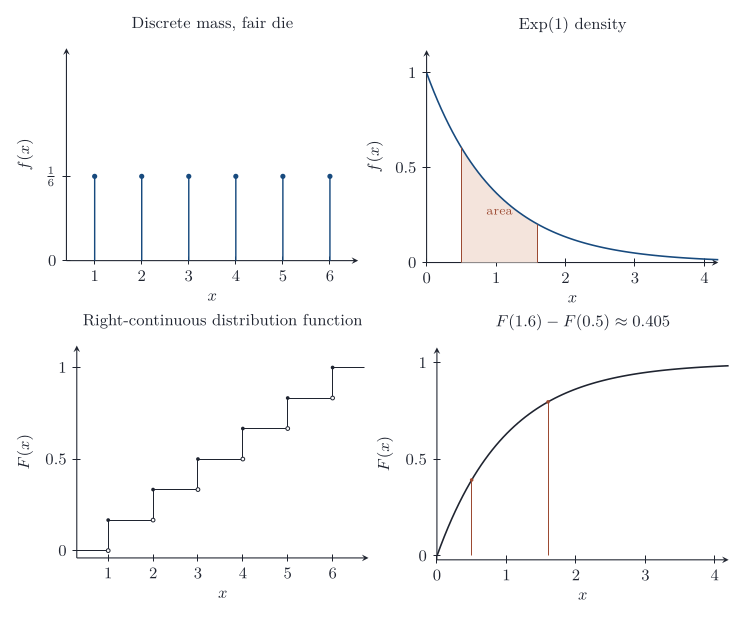
| Type | Definition |
| Taught in | Random variables and distributions |
| Part | Probability |
| Properties | 1 |
| Worked examples | 2 |
| Questions using it | 7 |
The cumulative distribution function of X is F(x)=\mathbb{P}(X\le x), for x\in\mathbb{R}.
Properties
Inverse-transform method
Main article: Inverse-transform method
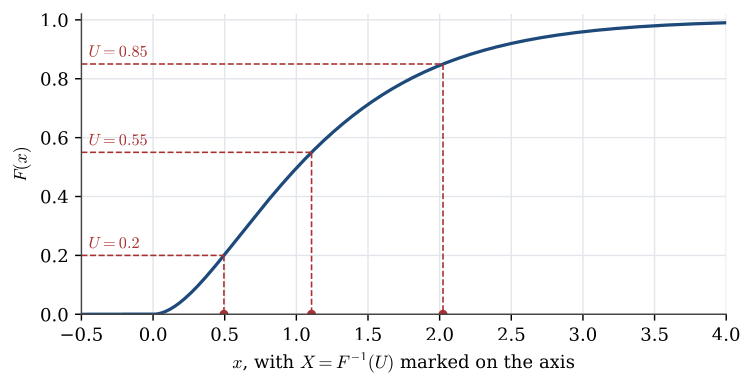
Let F be a distribution function and define F^{-1}(u)=\inf\{x:F(x)\ge u\} for u\in(0,1). If U\sim\operatorname{U}[0,1], then X=F^{-1}(U) has distribution function F.
Examples
A cubic distribution function
Question page: A cubic distribution function
A continuous random variable X has distribution function F(x)=0 for x<0, F(x)=x^3 for x\in[0,1], and F(x)=1 for x>1.
Find the density of X.
Calculate \mathbb{P}(1/2<X<3/4).
Calculate \mathbb{E} X.
f(x)=F'(x)=3x^2 for 0<x<1, and f(x)=0 elsewhere.
\mathbb{P}(1/2<X<3/4)=F(3/4)-F(1/2)=(3/4)^3-(1/2)^3=19/64.
\mathbb{E} X=\int_0^1 x\cdot 3x^2\,\,\mathrm{d} x=3/4.
Distribution function of a maximum
Question page: Distribution function of a maximum
Let X_1,\ldots,X_n be independent with distribution functions F_1,\ldots,F_n. Express the distribution function of M=\max(X_1,\ldots,X_n) in terms of F_1,\ldots,F_n.
The maximum is at most m when every variable is at most m. Independence factors the probability:
\mathbb{P}(M\le m)=F_1(m)\cdots F_n(m).
Figures
Used in
- Taught in Random variables and distributions, where the derivation and examples are.
- Also used in Simulation · Joint distributions · Functions of random variables and limit theorems · Reliability · Using R
- Questions that use it (7) — The larger coordinate · A cubic distribution function · Draws from an exponential law (answer) · A shifted exponential density (answer) · Minimum and average of uniform draws (answer) · Distribution function of a maximum · A normal law with mean 2
- All 27 questions on Random variables and distributions
See also
Central limit theorem · Continuous distribution · Exponential distribution · Inverse-transform method · Normal distribution · Survival function · Weibull distribution · Random variable