Inverse-transform method
Definition taught in Simulation, part of Probability
Inverse-transform method
| Type | Definition |
| Taught in | Simulation |
| Part | Probability |
| Worked examples | 2 |
| Questions using it | 1 |
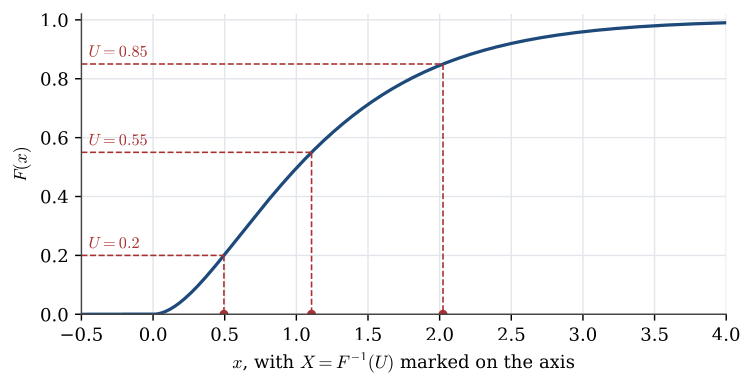
Let F be a distribution function and define F^{-1}(u)=\inf\{x:F(x)\ge u\} for u\in(0,1). If U\sim\operatorname{U}[0,1], then X=F^{-1}(U) has distribution function F.
Examples
Draws from an exponential law
Question page: Draws from an exponential law
Explain how to generate a draw from the exponential distribution with rate 10, starting from a uniform draw on [0,1].
Draw U\sim\operatorname{U}[0,1] and return X=-\log(U)/10. This is the inverse-transform method: the distribution function 1-e^{-10x} inverts to -\log(1-u)/10, and 1-U has the same distribution as U.
A shifted exponential density
Question page: A shifted exponential density
A density is f(x)=4e^{-4(x-1)} for x\ge 1, and f(x)=0 otherwise.
Find the expectation of a random variable with this density.
Explain how to generate such a random variable from a single uniform draw on [0,1].
If X has this density, then Y=X-1 has density 4e^{-4y} for y\ge0, which is \operatorname{Exp}(4). So \mathbb{E} X=1+1/4=1.25.
The distribution function is F(x)=1-e^{-4(x-1)} for x\ge1. Solving F(x)=u gives x=1-\tfrac14\log(1-u). Draw U\sim\operatorname{U}[0,1] and return 1-\tfrac14\log U, using that 1-U is again uniform.
Used in
- Taught in Simulation, where the derivation and examples are.
- Questions that use it (1) — Draws from an exponential law (answer)
- All 4 questions on Simulation
See also
Cumulative distribution function · Linear congruential generator · Acceptance–rejection method