Survival function
Definition taught in Reliability, part of Probability
Survival function
| Type | Definition |
| Taught in | Reliability |
| Part | Probability |
| Worked examples | 3 |
| Questions using it | 3 |
The survival function of a lifetime T with distribution function F is R(t)=\mathbb{P}(T>t)=1-F(t) for t\ge 0.
Examples
Mean lifetimes of redundant systems
Worked example from Reliability
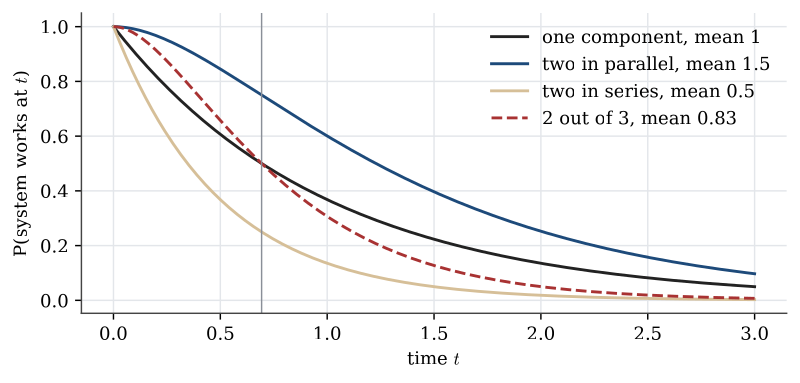
Components have independent exponential lifetimes with rate \lambda, so each has mean 1/\lambda.
Question. Compare the mean lifetimes of one component, two components in parallel, and a 2-out-of-3 system.
Solution. The mean is the integral of the survival function. With q(t)=e^{-\lambda t}, two in parallel survive with probability 1-(1-q)^2=2q-q^2, so
\mathbb{E} T=\int_0^\infty\bigl(2e^{-\lambda t}-e^{-2\lambda t}\bigr)\,\mathrm{d} t=\frac2\lambda-\frac1{2\lambda}=\frac3{2\lambda}.
A 2-out-of-3 system survives with probability 3q^2(1-q)+q^3=3q^2-2q^3, so
\mathbb{E} T=\int_0^\infty\bigl(3e^{-2\lambda t}-2e^{-3\lambda t}\bigr)\,\mathrm{d} t=\frac3{2\lambda}-\frac2{3\lambda}=\frac5{6\lambda}.
The 2-out-of-3 system lives on average less long than a single component, even though at p=0.9 its reliability, 0.972, beats a single component’s 0.9. Redundancy helps while components are likely to be working, early on, and hurts later, when the system needs two survivors out of a shrinking pool. A reliability at one time and a mean lifetime answer different questions.
Mean life as an integral of survival
Question page: Mean life as an integral of survival
Let T\ge 0 have survival function R. Show that \mathbb{E} T=\int_0^{\infty} R(t)\,\,\mathrm{d} t, assuming the integral is finite.
Write T=\int_0^T1\,\,\mathrm{d} t=\int_0^\infty\mathbf 1\{t<T\}\,\,\mathrm{d} t. The integrand is non-negative, so expectation and integral may be exchanged (Tonelli’s theorem):
\mathbb{E} T=\int_0^\infty\mathbb{E}\,\mathbf 1\{t<T\}\,\,\mathrm{d} t=\int_0^\infty\mathbb{P}(T>t)\,\,\mathrm{d} t=\int_0^\infty R(t)\,\,\mathrm{d} t.
With a density, the same follows from integration by parts: \int_0^\infty tf(t)\,\,\mathrm{d} t=[-tR(t)]_0^\infty+\int_0^\infty R(t)\,\,\mathrm{d} t, and the boundary term vanishes when the mean is finite.
A string of twenty bulbs
Question page: A string of twenty bulbs
Twenty bulbs are wired in series, so the string fails when the first bulb fails. Each bulb’s lifetime is exponential with expectation 1000 hours, and the lifetimes are independent. Find the distribution of the lifetime of the string, and its expectation.
The string’s lifetime is T=\min_iT_i. Each T_i has survival function e^{-t/1000}, so
\mathbb{P}(T>t)=\prod_{i=1}^{20}e^{-t/1000}=e^{-20t/1000}=e^{-t/50}.
T is exponential with rate 1/50 per hour, and \mathbb{E} T=50 hours.
Used in
- Taught in Reliability, where the derivation and examples are.
- Also used in Functions of random variables and limit theorems
- Questions that use it (3) — A string of twenty bulbs (answer) · Mean life as an integral of survival · Survival from the hazard
- All 7 questions on Reliability
See also
Cumulative distribution function · Hazard rate · Weibull distribution · Structure function · Reliability function