Reliability function
Definition taught in Reliability, part of Probability
Reliability function
| Type | Definition |
| Taught in | Reliability |
| Part | Probability |
| Worked examples | 3 |
Under independent component states, the reliability function is r(\mathbf{p})=\mathbb{P}(\varphi(\mathbf{X})=1), a function of the vector \mathbf{p}=(p_1,\ldots,p_n).
Examples
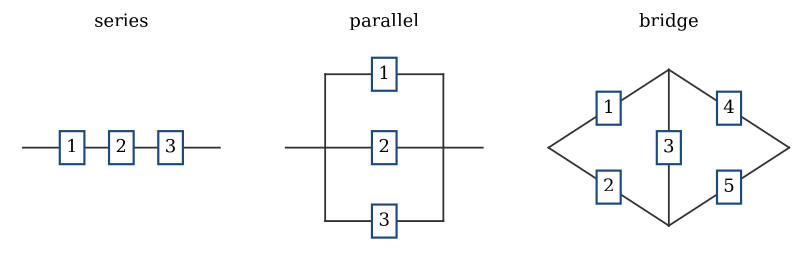
A bridge of reliable links
Worked example from Reliability
Each of the five components of the bridge works with probability p=0.9, independently.
Question. Find the reliability of the bridge exactly, and by the rare-event approximation.
Solution. With every p_i=p the polynomial above collapses to
r(p)=2p^2+2p^3-5p^4+2p^5,
so r(0.9)=1.62+1.458-3.2805+1.181=0.9785. For the approximation, the minimal cuts \{1,2\} and \{4,5\} each fail with probability 0.1^2=0.01, and \{1,3,5\} and \{2,3,4\} each with 0.1^3=0.001, so
r\approx1-(0.01+0.01+0.001+0.001)=0.978.
The approximation is good to three decimal places, because with reliable components two cuts almost never fail together. It also shows where the risk is: the two-component cuts at each end contribute ten times as much as the three-component cuts through the cross link. For comparison, two parallel series paths without the cross link have reliability 1-(1-0.81)^2=0.964, so the link removes about 40% of the failure probability.
Mean lifetimes of redundant systems
Worked example from Reliability
Components have independent exponential lifetimes with rate \lambda, so each has mean 1/\lambda.
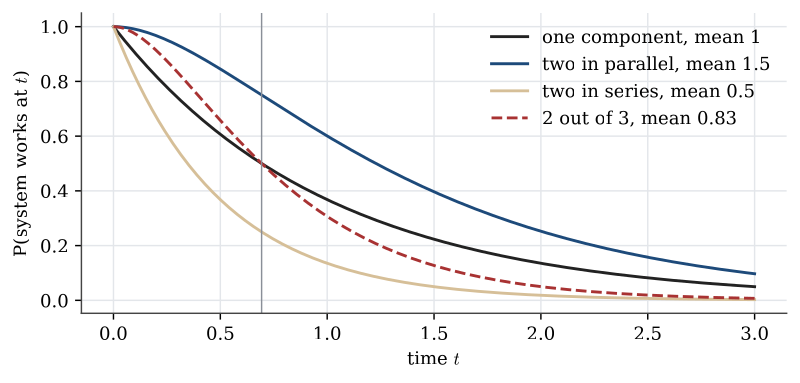
Question. Compare the mean lifetimes of one component, two components in parallel, and a 2-out-of-3 system.
Solution. The mean is the integral of the survival function. With q(t)=e^{-\lambda t}, two in parallel survive with probability 1-(1-q)^2=2q-q^2, so
\mathbb{E} T=\int_0^\infty\bigl(2e^{-\lambda t}-e^{-2\lambda t}\bigr)\,\mathrm{d} t=\frac2\lambda-\frac1{2\lambda}=\frac3{2\lambda}.
A 2-out-of-3 system survives with probability 3q^2(1-q)+q^3=3q^2-2q^3, so
\mathbb{E} T=\int_0^\infty\bigl(3e^{-2\lambda t}-2e^{-3\lambda t}\bigr)\,\mathrm{d} t=\frac3{2\lambda}-\frac2{3\lambda}=\frac5{6\lambda}.
The 2-out-of-3 system lives on average less long than a single component, even though at p=0.9 its reliability, 0.972, beats a single component’s 0.9. Redundancy helps while components are likely to be working, early on, and hurts later, when the system needs two survivors out of a shrinking pool. A reliability at one time and a mean lifetime answer different questions.
Three components, one of them essential
Question page: Three components, one of them essential
Components 1, 2 and 3 fail independently with probability 0.1 each. The system works when component 1 works and at least one of components 2 and 3 works. Find the probability that the system works.
Let A_i be the event that component i works, so \mathbb{P}(A_i)=0.9. The system works on A_1\cap(A_2\cup A_3). Independence gives
\mathbb{P}(A_2\cup A_3)=0.9+0.9-0.9^2=0.99,
and the system probability is 0.9\times 0.99=0.891.
Figures
Used in
- Taught in Reliability, where the derivation and examples are.
- All 7 questions on Reliability
See also
Structure function · Survival function · Hazard rate · Weibull distribution