Law of large numbers
Theorem taught in Functions of random variables and limit theorems, part of Probability
Law of large numbers
| Type | Theorem |
| Taught in | Functions of random variables and limit theorems |
| Part | Probability |
| Worked examples | 1 |
| Questions using it | 6 |
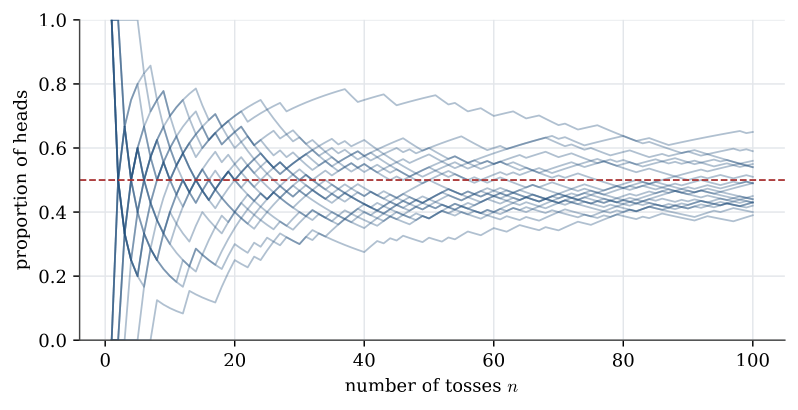
If the mean \mu exists, the strong law says
\mathbb{P}\Bigl(\lim_{n\to\infty} S_n/n=\mu\Bigr)=1.
If in addition the variance is finite, the weak law says that for every \varepsilon>0,
\lim_{n\to\infty}\mathbb{P}\bigl(|S_n/n-\mu|>\varepsilon\bigr)=0.
The weak law under a finite variance follows from Chebyshev’s inequality: \mathbb{P}(|S_n/n-\mu|>\varepsilon)\le \operatorname{Var}(S_n/n)/\varepsilon^2=\operatorname{Var}(X_1)/(n\varepsilon^2), which tends to zero.
Examples
The mean of repeated voltage readings
Question page: The mean of repeated voltage readings
Voltage readings X_1,\ldots,X_n are independent and \operatorname{N}(\mu,\sigma^2), with \mu and \sigma^2 unknown. Let \overline X=(X_1+\cdots+X_n)/n, and suppose x_1,\ldots,x_n are the observed values.
What function of the observations estimates \mu?
Show that \mathbb{E}\overline X=\mu.
Show that \operatorname{Var}(\overline X)\to 0 as n\to\infty.
State the distribution of \overline X.
What do (b) and (c) say about the estimate in (a)?
Use the sample average \overline x=(x_1+\cdots+x_n)/n.
\mathbb{E}\overline X=n^{-1}(\mathbb{E} X_1+\cdots+\mathbb{E} X_n)=\mu.
Independence gives \operatorname{Var}(\overline X)=\sigma^2/n, which tends to 0.
An affine image of independent normals is normal, so \overline X\sim\operatorname{N}(\mu,\sigma^2/n).
The estimate is unbiased at every n, and its variance disappears as more readings are taken, so \overline x concentrates on \mu.
Used in
- Taught in Functions of random variables and limit theorems, where the derivation and examples are.
- Also used in Markov chains · Classes, recurrence, and reversibility · Statistical inference
- Questions that use it (6) — A Poisson mean (answer) · A logit-normal prior for a coin (answer) · Q27 (answer) · Q28 (answer) · Question 1 (answer) · Question 7 (answer)
- All 21 questions on Functions of random variables and limit theorems
See also
Transformation rule · Multivariate normal distribution · Affine images of normal vectors · Normal linear model · Central limit theorem