Student t distribution
Definition taught in Statistical inference, part of Statistical inference
Student t distribution
| Type | Definition |
| Taught in | Statistical inference |
| Part | Statistical inference |
| Properties | 3 |
| Worked examples | 2 |
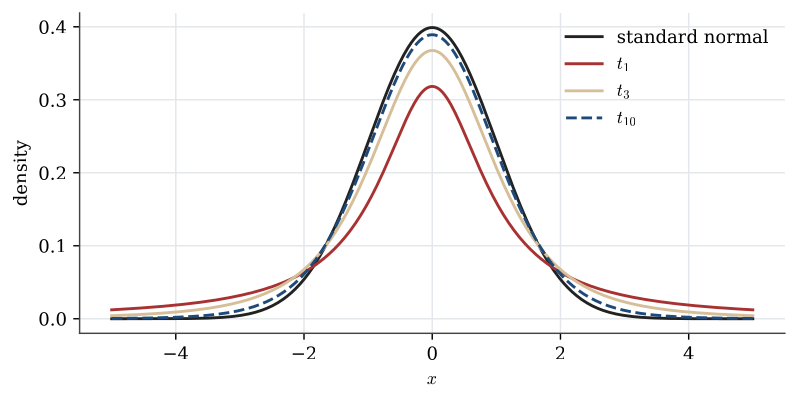
If Z is standard normal, V is \chi^2_m, and Z and V are independent, then T=Z/\sqrt{V/m} has the Student t distribution with m degrees of freedom, written t_m.
Properties
One-sample t pivot
Main article: One-sample t pivot
If X_1,\ldots,X_n are independent and \operatorname{N}(\mu,\sigma^2), then
T=\frac{\overline X-\mu}{s/\sqrt n}
has a Student t distribution with n-1 degrees of freedom. A Student variable with m degrees of freedom is Z/\sqrt{V/m} where Z is standard normal, V is chi-squared with m degrees of freedom, and Z and V are independent.
Two-sample t pivot
Main article: Two-sample t pivot
For two independent normal samples with a common variance,
T=\frac{(\overline X_1-\overline X_2)-(\mu_1-\mu_2)}{s_p\sqrt{1/n_1+1/n_2}}
has a t distribution with n_1+n_2-2 degrees of freedom.
Slope t pivot
Main article: Slope t pivot
Under simple linear regression,
\frac{\widehat\beta_1-\beta_1}{S_1}=\frac{\widehat\beta_1-\beta_1}{S/\sqrt{S_{xx}}}
has the t_{n-2} distribution.
Examples
The volume of a drop
Worked example from Estimation examples
A burette reads 25.36 mL, then 22.84 mL after 50 drops, then 20.36 mL after another 50.
Question. Give a 95% interval for the volume of one drop.
Solution. The two batches of 50 drops have volumes x_1=2.52 and x_2=2.48 mL. Model them as a \operatorname{N}(\mu,\sigma^2) sample of size n=2, where \mu is the expected volume of 50 drops. Then \overline x=2.50, s=0.02\sqrt2, and the standard error is s/\sqrt2=0.02. With one degree of freedom t_{1;0.975}=12.71, so the interval for \mu is
2.50\pm12.71\times0.02=(2.25,\ 2.75).
Dividing by 50, a monotone change of scale, gives a 95% interval for one drop of (0.045,\ 0.055) mL. The huge quantile 12.71 is the price of estimating a standard deviation from two numbers.
A squared t variable
Question page: A squared t variable
Using only the definitions of the t and F distributions, show that if T\sim t_m then T^2\sim F_{1,m}. Hence explain why a two-sided t test at level \alpha and an F test with one numerator degree of freedom reject on the same samples.
Write T=Z/\sqrt{V/m} with Z standard normal, V\sim\chi^2_m and the two independent. Then
T^2=\frac{Z^2/1}{V/m}.
Z^2 is \chi^2_1 by definition, and it is independent of V, so T^2 is F_{1,m}.
The two-sided t test rejects when |T|\ge t_{m;1-\alpha/2}, that is when T^2\ge t_{m;1-\alpha/2}^2. Because \mathbb{P}(T^2\le c^2)=\mathbb{P}(-c\le T\le c), the quantile F_{1,m;1-\alpha} equals t_{m;1-\alpha/2}^2. For example, t_{4;0.975}^2=2.776^2=7.71=F_{1,4;0.95}. The two tests reject on the same samples.
Used in
- Taught in Statistical inference, where the derivation and examples are.
- All 4 questions on Statistical inference
See also
Random sample · Statistic · Moments of the sample mean and variance · Chi-squared distribution · F distribution · Normal sample theorem