Observational study
Definition taught in Studies, data, and evidence, part of Data analysis
Observational study
| Type | Definition |
| Taught in | Studies, data, and evidence |
| Part | Data analysis |
| Worked examples | 2 |
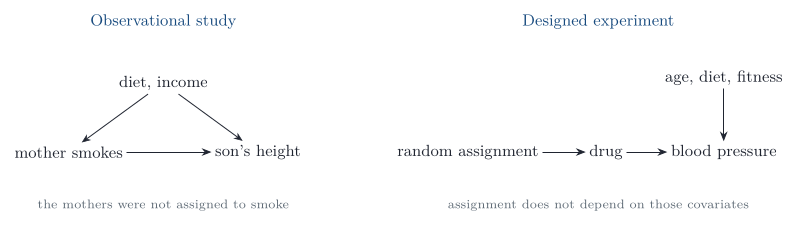
In an observational study the investigator does not assign the conditions being compared. A survey is the usual case. Repeating the study would produce new values in every column, because a new set of units is encountered and nothing was fixed by design.
Examples
Alcohol and school attendance
Question page: Alcohol and school attendance
A sample of 7874 adolescents is linked to a school registry. Frequent intoxication is recorded as a yes-or-no classification, collapsed from a five-point question. After accounting for age, sex, socio-economic status, and mental health, adolescents who were frequently intoxicated missed more hours of school.
Is this an observational study or a designed experiment?
What values can frequent intoxication take, and what type of variable is it?
What values can hours missed take, and what type of variable is it?
Which variable is the response, and why?
Which variables are explanatory?
Observational: nobody assigned the adolescents to be frequently intoxicated or not. The association with absence, even after adjustment, may be due to variables that were not recorded.
Two values, yes or no, so it is a binary categorical variable. It was collapsed from a five-point ordinal question, which throws away some information.
Hours missed can be any non-negative number, so it is quantitative. Recorded in whole hours it is discrete, and it is likely to be right-skewed, with many students missing little school and a few missing a lot.
Hours missed is the response, because the study asks whether intoxication goes with more missed school.
Frequent intoxication is the explanatory variable of interest. Age, sex, socio-economic status and mental health are also explanatory variables, included to adjust for possible confounding.
Facial tumours in Tasmanian devils
Question page: Facial tumours in Tasmanian devils
Thirty devils with facial tumours are split into two groups of 15. One group receives a new medicine and the other is untreated. Tumour size is recorded at the start and after 12 weeks.
Is this an observational study or a designed experiment? What is missing from the description before the quality of the comparison can be judged?
Which variable is the response, and what type of variable is it?
Which variable is explanatory, and what type of variable is it?
It is a designed experiment: the investigators decided which devils got the medicine. Before judging it we would want to know whether the groups were formed at random, whether whoever measured the tumours knew which devils were treated, whether the untreated group received a placebo or at least the same handling, and how comparable the devils were at the start in age, sex and tumour size. Fifteen per group is small, so a modest effect could be missed. Tumour size alone may also miss what matters, such as survival.
The response is the change in tumour size over the 12 weeks, or the size at 12 weeks adjusted for the starting size. It is quantitative and continuous. The question is whether the medicine changes it.
The explanatory variable is the treatment, medicine or none. It is categorical, a factor with two levels, and it is set by the investigators.
Used in
- Taught in Studies, data, and evidence, where the derivation and examples are.
- All 6 questions on Studies, data, and evidence
See also
Designed experiment · Randomised controlled trial · Confounding variable · Blinding and placebo · Simple random sample · Stratified and cluster sampling