Confounding variable
Definition taught in Studies, data, and evidence, part of Data analysis
Confounding variable
| Type | Definition |
| Taught in | Studies, data, and evidence |
| Part | Data analysis |
| Worked examples | 1 |
| Questions using it | 1 |
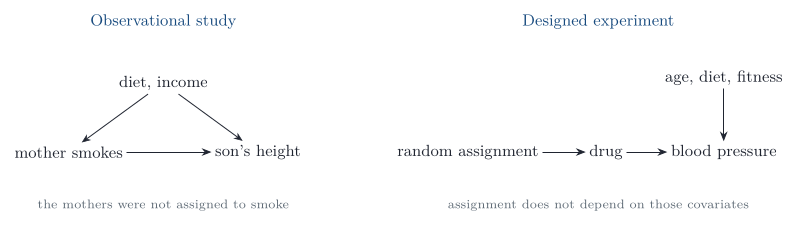
A confounding variable affects both the explanatory variable and the response, so that an association between those two can appear, disappear or reverse when the confounder is taken into account.
Examples
Reading a correlation
Question page: Reading a correlation
The sample correlation between \log_{10} serum creatinine and serum sodium in a heart-failure cohort is -0.26, and the correlation between \log_{10} serum creatinine and age is 0.23.
Which pair moves together, and which pair moves in opposite directions?
Why is neither correlation, by itself, a reason to conclude that one variable causes the other?
Serum creatinine and age move together: the correlation 0.23 is positive, so older patients tend to have somewhat higher creatinine. Creatinine and sodium move in opposite directions: the correlation -0.26 is negative. Both are weak; a correlation of about \pm0.25 means a straight line accounts for only about 6% of the variance of either variable.
A correlation measures linear association in this sample only. It can arise because a third variable drives both, here perhaps overall illness or kidney function, because the causal arrow points the other way, or by chance. These are observational data, so nothing was assigned and no causal reading follows from the correlation alone.
Used in
- Taught in Studies, data, and evidence, where the derivation and examples are.
- Also used in Marginal models, and two responses at once
- Questions that use it (1) — Alcohol and school attendance (answer)
- All 6 questions on Studies, data, and evidence
See also
Observational study · Designed experiment · Randomised controlled trial · Blinding and placebo · Simple random sample · Stratified and cluster sampling