Randomised block design
Definition taught in Analysis of variance, part of Statistical inference
Randomised block design
| Type | Definition |
| Taught in | Analysis of variance |
| Part | Statistical inference |
| Properties | 1 |
| Worked examples | 2 |
| Questions using it | 2 |
A randomised block design measures every one of t treatments once in each of b blocks. The response for block i and treatment j is
Y_{ij}=\mu+\beta_i+\tau_j+\varepsilon_{ij}, \qquad \sum_{i=1}^b\beta_i=0,\quad\sum_{j=1}^t\tau_j=0,
with \varepsilon_{ij} independent and \operatorname{N}(0,\sigma^2). Here \mu is the overall mean, \beta_i the effect of block i and \tau_j the effect of treatment j.
Properties
ANOVA F distribution
Main article: ANOVA F distribution
In the one-way model, \mathrm{SS}_{\mathrm{error}}/\sigma^2 is \chi^2_{n-k}, and it is independent of \mathrm{SS}_{\mathrm{treatment}}. Under H_0:\mu_1=\cdots=\mu_k, \mathrm{SS}_{\mathrm{treatment}}/\sigma^2 is \chi^2_{k-1}, and therefore
F=\frac{\mathrm{SS}_{\mathrm{treatment}}/(k-1)}{\mathrm{SS}_{\mathrm{error}}/(n-k)}=\frac{\mathrm{MS}_{\mathrm{treatment}}}{\mathrm{MS}_{\mathrm{error}}}
has the F_{k-1,\,n-k} distribution.
Examples
Tips and coupons
Question page: Tips and coupons
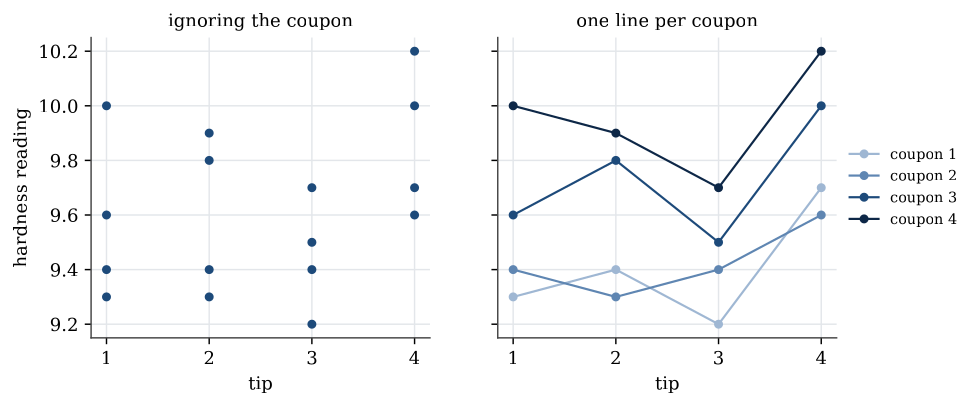
Hardness readings for four tips on four metal coupons are
| Tip 1 | Tip 2 | Tip 3 | Tip 4 | |
|---|---|---|---|---|
| Coupon 1 | 9.3 | 9.4 | 9.2 | 9.7 |
| Coupon 2 | 9.4 | 9.3 | 9.4 | 9.6 |
| Coupon 3 | 9.6 | 9.8 | 9.5 | 10.0 |
| Coupon 4 | 10.0 | 9.9 | 9.7 | 10.2 |
Treat coupons as blocks and tips as treatments in a randomised block design, with one observation per cell. Compute the two F statistics and state the conclusion of each test at level 0.05. The 0.95 quantile of F_{3,9} is about 3.86.
The grand mean of the 16 readings is 9.625. The tip means, the column means, are 9.575, 9.600, 9.450 and 9.875, so
\mathrm{SS}_{\mathrm{tip}}=4\sum_j(\overline y_{\cdot j}-9.625)^2=0.385, \qquad \mathrm{MS}_{\mathrm{tip}}=0.385/3=0.1283.
The coupon means, the row means, are 9.400, 9.425, 9.725 and 9.950, and \mathrm{SS}_{\mathrm{coupon}}=0.825, so \mathrm{MS}_{\mathrm{coupon}}=0.275. The total sum of squares is 1.290, so the error sum of squares is 1.290-0.385-0.825=0.080, on (4-1)(4-1)=9 degrees of freedom, and \mathrm{MS}_{\mathrm{error}}=0.008889.
F_{\mathrm{tip}}=\frac{0.1283}{0.008889}\approx 14.44, \qquad F_{\mathrm{coupon}}=\frac{0.275}{0.008889}\approx 30.94.
Both exceed 3.86. At level 0.05 the test rejects equal tip means, and the coupons also differ, which shows that blocking on the coupon removed a large source of variation from the error.
Two treatments in blocks
Question page: Two treatments in blocks
In a randomised block design with t=2 treatments, the treatment F test and the paired t test on the within-block differences are equivalent. Show that the F statistic is the square of that paired t statistic, and that the level-\alpha critical regions agree.
Let D_i=Y_{i1}-Y_{i2} for block i=1,\ldots,b, with mean \overline D and variance s_D^2. The paired statistic is T=\overline D/(s_D/\sqrt b), on b-1 degrees of freedom.
The treatment means are \overline Y_{\cdot1} and \overline Y_{\cdot2}, with \overline Y_{\cdot1}-\overline Y_{\cdot2}=\overline D and grand mean halfway between them. So
\mathrm{SS}_{\mathrm{treatment}}=b\Bigl[\bigl(\tfrac{\overline D}2\bigr)^2+\bigl(\tfrac{\overline D}2\bigr)^2\Bigr]=\frac{b\overline D^2}{2},
on t-1=1 degree of freedom. The error residual in block i for treatment 1 is Y_{i1}-\overline Y_{i\cdot}-\overline Y_{\cdot1}+\overline Y_{\cdot\cdot}=\tfrac12(D_i-\overline D), and for treatment 2 it is the negative of that. Hence
\mathrm{SS}_{\mathrm{error}}=\sum_{i=1}^b2\cdot\tfrac14(D_i-\overline D)^2=\frac{(b-1)s_D^2}{2},
on (b-1)(2-1)=b-1 degrees of freedom, so \mathrm{MS}_{\mathrm{error}}=s_D^2/2. Then
F=\frac{b\overline D^2/2}{s_D^2/2}=\frac{\overline D^2}{s_D^2/b}=T^2.
F is F_{1,b-1} and T is t_{b-1}, and F_{1,b-1;1-\alpha}=t_{b-1;1-\alpha/2}^2, so F\ge F_{1,b-1;1-\alpha} exactly when |T|\ge t_{b-1;1-\alpha/2}. The two level-\alpha tests reject on the same data. For the tyres, T=12.83 and F=164.6=12.83^2.
Used in
- Taught in Analysis of variance, where the derivation and examples are.
- Also used in Analysis of variance examples
- Questions that use it (2) — Tips and coupons · Two treatments in blocks
- All 6 questions on Analysis of variance
See also
One-way analysis of variance · ANOVA sum of squares decomposition · ANOVA F distribution · Contrast · Tukey intervals