Critical region
Definition taught in Hypothesis tests, part of Statistical inference
Critical region
| Type | Definition |
| Taught in | Hypothesis tests |
| Part | Statistical inference |
| Worked examples | 3 |
| Questions using it | 2 |
A critical region C is a set of values of the test statistic. The test rejects H_0 when T\in C. A right-sided region is [c,\infty), a left-sided region is (-\infty,c], and a two-sided region is (-\infty,c_1]\cup[c_2,\infty).
Examples
Caffeine in cola
Worked example from Hypothesis tests
A claim is that regular cola contains 19 mg of caffeine per serving. For n=40 servings of another brand, \overline x=19.57 mg and s=1.40 mg.
Question. At level 0.01, is the mean caffeine content of this brand more than 19 mg?
Solution. Model the servings as a normal random sample. Test H_0:\mu=19 against H_1:\mu>19. The statistic is
t=\frac{19.57-19}{1.40/\sqrt{40}}=2.575,
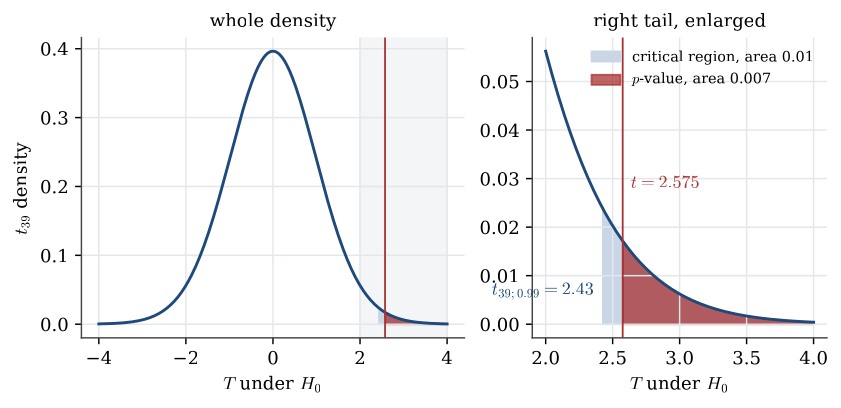
against t_{39}. The critical value is t_{39;0.99}=2.43, so t is in the critical region, and the p-value is 0.007. Reject H_0: there is strong evidence that the mean exceeds 19 mg.
Statistical significance is not practical significance. The one-sided 99% lower confidence bound is 19.57-2.43\times1.40/\sqrt{40}=19.03, so the data are consistent with a mean barely above 19. The two-sided 99% interval, (18.97,\ 20.17), even includes 19, because it spends only half its error on each side. Whether a mean of 19.5 or 20 mg matters for health is a question the test cannot answer.
Tuning-fork variability
Worked example from Hypothesis tests
Tuning-fork frequencies have been \operatorname{N}(\mu,1.1). A new process is meant to reduce the variance. A batch of 7 new forks has sample variance 0.488.
Question. Is there evidence that the new process has smaller variance?
Solution. Test H_0:\sigma^2=1.1 against H_1:\sigma^2<1.1 with 6s^2/1.1, which is \chi^2_6 under H_0. Its value is 6\times0.488/1.1=2.66, and the p-value is \mathbb{P}(\chi^2_6\le2.66)=0.15. At level 0.05 the critical region is (0,\ 1.635], and 2.66 is not in it. There is not enough evidence that the new process is less variable. With only 7 forks, the sample variance would have to be below 0.30 to reject.
A critical region for a known variance
Question page: A critical region for a known variance
Systolic blood pressure in a reference population has mean 127 and standard deviation 7. A sample of 101 people from another group has sample mean \overline X. Assume the readings are independent and normal with that same standard deviation, and mean \mu. The test statistic is
T=\frac{\overline X-127}{7/\sqrt{101}}.
Find the two-sided critical region for T, and the corresponding region for \overline X, at significance level 0.05. Use z_{0.975}=1.960.
Under H_0:\mu=127, T is standard normal. The two-sided level-0.05 region is |T|\ge 1.960. Because the standard error is 7/\sqrt{101}\approx 0.6965,
|\overline X-127|\ge 1.960\times 0.6965\approx 1.365.
Reject when \overline X\le 125.635 or \overline X\ge 128.365. The observed mean of 130 is well inside the region.
Used in
- Taught in Hypothesis tests, where the derivation and examples are.
- Questions that use it (2) — A critical region for a known variance · Two treatments in blocks
- All 6 questions on Hypothesis tests
See also
Neyman–Pearson approach · Power function · Two-sample t test · Null and alternative hypotheses · p-value · Type I and type II errors · One-sample t test · F test for equal variances