Gibbs sampling as an always-accepted MH update
Section of Markov chains, Gibbs sampling, and Metropolis–Hastings, part of Bayesian statistics
Gibbs sampling as an always-accepted MH update
| Type | Section |
| Taught in | Markov chains, Gibbs sampling, and Metropolis–Hastings |
| Part | Bayesian statistics |
The connection with Gibbs sampling can be made exact. Suppose the current state is {\boldsymbol{x}}=(x_1,x_2)^{\mathsf T} and we update only the first coordinate by proposing
{\boldsymbol{y}}=(y_1,x_2)^{\mathsf T}, \qquad y_1\sim\pi(\,\cdot\mid x_2).
Then
q({\boldsymbol{y}}\mid{\boldsymbol{x}})=\pi(y_1\mid x_2), \qquad q({\boldsymbol{x}}\mid{\boldsymbol{y}})=\pi(x_1\mid x_2).
Using joint equals conditional times marginal, the Hastings ratio is \begin{align*} r({\boldsymbol{x}},{\boldsymbol{y}}) &=\frac{\pi(y_1,x_2)\pi(x_1\mid x_2)} {\pi(x_1,x_2)\pi(y_1\mid x_2)}\\ &=\frac{\pi(y_1\mid x_2)\pi(x_2) \pi(x_1\mid x_2)} {\pi(x_1\mid x_2)\pi(x_2) \pi(y_1\mid x_2)}\\ &=1. \end{align*} Every Gibbs coordinate proposal is therefore accepted. This does not imply that every Gibbs sampler moves efficiently. In the bivariate-normal example, as |\rho|\to1 the conditional standard deviation \sqrt{1-\rho^2} tends to zero: acceptance remains one while successive states move only a very short distance.
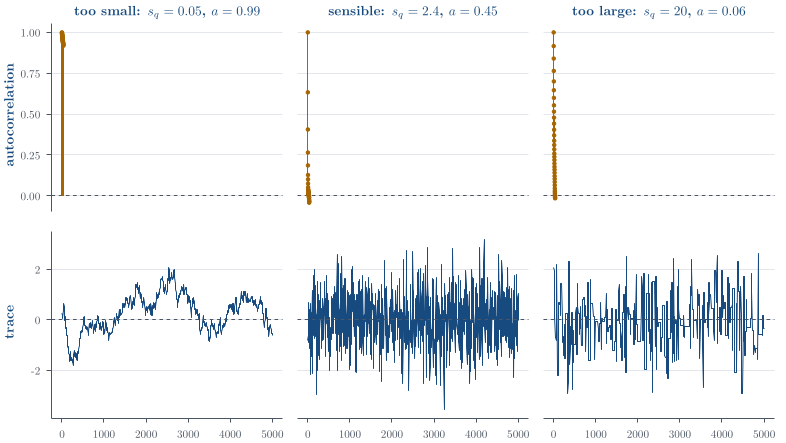
Proposal design is an art because local and global exploration pull in different directions. Tiny random-walk steps are accepted but travel slowly; huge steps travel far but are mostly rejected. An independent proposal can jump between modes, yet it wastes effort if it puts mass where the target has almost none. The Hastings correction guarantees the right equilibrium under the required conditions; it does not guarantee an efficient journey there.
Used in
See also
Markov chain · Stationarity and detailed balance · Detailed balance implies stationarity · Systematic-scan Gibbs sampler · Warm-up is not a convergence proof · Metropolis–Hastings update · Metropolis–Hastings invariance · Markov chains and equilibrium