Warm-up is not a convergence proof
Remark taught in Markov chains, Gibbs sampling, and Metropolis–Hastings, part of Bayesian statistics
Warm-up is not a convergence proof
| Type | Remark |
| Taught in | Markov chains, Gibbs sampling, and Metropolis–Hastings |
| Part | Bayesian statistics |
| Worked examples | 2 |
| Questions using it | 13 |
The chain should be initialised in a plausible region when one is available. A start many standard deviations from the typical set can require a long time to return, while a start at the mean of a separated mixture can lie in a low-density gap. Multiple dispersed chains help reveal failure to explore all modes; they do not repair it automatically.
Discarding early draws is called warm-up or burn-in. It limits dependence on the chosen initial state, but it is not a proof of convergence. Strong posterior correlation produces staircase-like Gibbs paths and high autocorrelation. Separated modes are harder still because a coordinate-wise move may have to cross a low-density barrier.
Thinning by retaining every kth draw reduces storage and visible serial dependence, but usually throws away usable information. Unless storage or an expensive downstream calculation is the constraint, retain all post-warm-up draws and quantify their effective sample size. Posterior means, probabilities, and equal-tailed intervals are computed from those draws; a continuous MAP is found by optimisation, not by asking which simulated value occurred most often.
Examples
C15. Warm-up and dependence
Question page: C15. Warm-up and dependence
Does discarding MCMC warm-up guarantee convergence or make the retained draws independent? Explain briefly.
Definitions/notation. Warm-up (burn-in) is an initial segment discarded to reduce the influence of initialisation. Discarding it neither proves convergence nor removes serial dependence: even a chain at equilibrium generally has dependent successive states, so mixing and Monte Carlo precision still need assessment.
Q19. Assessing a Metropolis–Hastings sampler
Question page: Q19. Assessing a Metropolis–Hastings sampler
[4 marks]
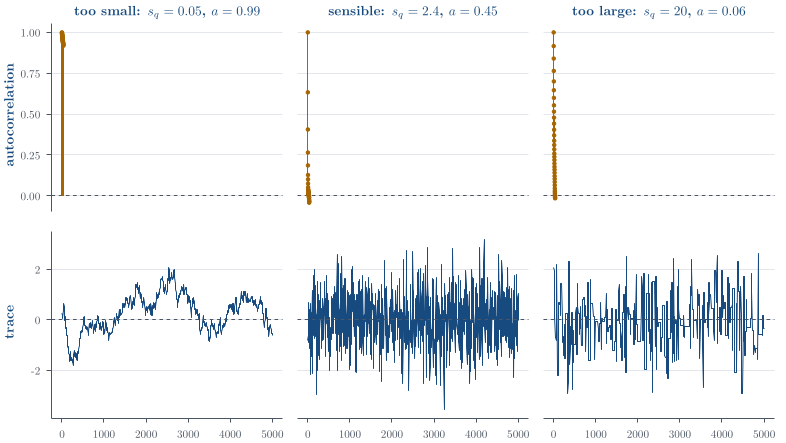
A researcher runs a random-walk Metropolis–Hastings sampler using a Normal proposal centred at the current state. The proposal standard deviation is very small, and approximately 99% of proposals are accepted. The researcher concludes that the sampler is highly efficient.
Explain why the acceptance rate alone does not justify this conclusion. Describe the behaviour you would expect from this sampler and identify one additional feature of its output that you would examine.
Definitions. The acceptance rate is the fraction of proposed moves accepted. Autocorrelation measures dependence between draws at different lags. For a chosen posterior summary, effective sample size is the number of independent target draws giving comparable Monte Carlo precision. Efficiency concerns that precision per unit of computation, not the acceptance fraction alone.
An acceptance rate of 99% does not by itself demonstrate efficiency. With a very small proposal standard deviation, proposed values lie close to the current state. The target density changes little across such a short move, so most proposals are accepted; however, each accepted move advances the chain only a small distance.
The expected consequences are slow exploration of the posterior and strong autocorrelation between successive draws. A large recorded sample may then contain information equivalent to a much smaller independent sample.
In addition to acceptance rate, useful diagnostics include:
a trace plot, to assess whether the chain explores the full target region;
the autocorrelation function, to measure serial dependence; and
the effective sample size, to quantify the independent information represented by the chain.
Thus a very high acceptance rate may indicate that the proposal scale is too small, not that the sampler is highly efficient.
An exact independent draw from the target would also have acceptance probability one and would be efficient. High acceptance is therefore neither sufficient evidence of efficiency nor inherently a fault; the movement and dependence matter.
Used in
- Taught in Markov chains, Gibbs sampling, and Metropolis–Hastings, where the derivation and examples are.
- Also used in Bayesian linear regression
- Questions that use it (13) — Metropolis–Hastings for the logit-normal posterior · Q4 (answer) · Q5 (answer) · Q25 (answer) · Q26 (answer) · Q42 (answer) · Q43 (answer) · Q58 (answer) · Question 3 (answer) · Question 9 (answer) · Question 12 (answer) · Question 16 (answer) · C15
- All 31 questions on Markov chains, Gibbs sampling, and Metropolis–Hastings
See also
Credible-region constructions · Direct posterior simulation · Markov chain · Stationarity and detailed balance · Detailed balance implies stationarity · Systematic-scan Gibbs sampler · Metropolis–Hastings update · Metropolis–Hastings invariance