Prior sensitivity
Section of The Beta–Binomial model, part of Bayesian statistics
Prior sensitivity
| Type | Section |
| Taught in | The Beta–Binomial model |
| Part | Bayesian statistics |
For n=10 tosses and x=3 heads, these three priors give \begin{align*} \operatorname{Beta}(5,5)&\longrightarrow\operatorname{Beta}(8,12),\\ \operatorname{Beta}(1,1)&\longrightarrow\operatorname{Beta}(4,8),\\ \operatorname{Beta}(0.6,0.6)&\longrightarrow\operatorname{Beta}(3.6,7.6). \end{align*} For example, under the uniform prior,
\mathbb{E}(\theta\mid x)=\frac4{12}=\frac13, \qquad \widehat\theta_{\mathrm{MAP}} =\frac{4-1}{4+8-2}=\frac3{10}=0.3.
The posterior probability of downward bias is
\mathbb{P}(\theta<0.5\mid x) =\int_0^{0.5}\frac{\theta^3(1-\theta)^7}{B(4,8)}\,\mathrm{d}\theta.
With n=100 and x=30 heads, the same priors give \begin{align*} \operatorname{Beta}(5,5)&\longrightarrow\operatorname{Beta}(35,75),\\ \operatorname{Beta}(1,1)&\longrightarrow\operatorname{Beta}(31,71),\\ \operatorname{Beta}(0.6,0.6)&\longrightarrow\operatorname{Beta}(30.6,70.6). \end{align*} The relative effect of the prior is smaller because the data contribute 100 counts while the first prior contributes a fixed amount.
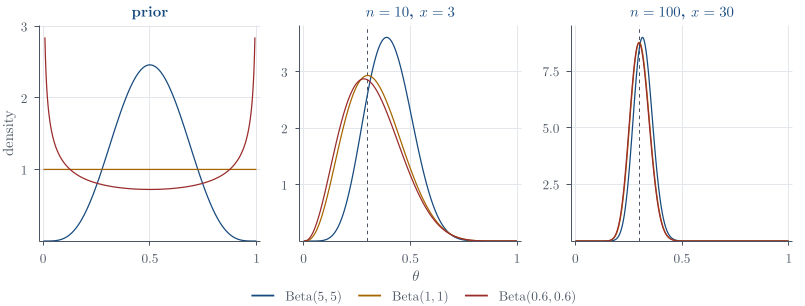
Direct substitution of x=30 in Equation (4) in The Beta–Binomial model gives the first shape parameters 35, 31, and 30.6 written above. The values 36, 32, and 31.6 are one unit larger and do not follow from that substitution. The second shape parameters that match x=30 are 75, 71, and 70.6.
Used in
- Taught in The Beta–Binomial model
- Also used in Bayesian computation in R
- All 11 questions on The Beta–Binomial model
See also
Beta distribution · Beta–Binomial conjugacy · Two pseudo-count conventions · Sequential coherence · Conjugacy is optional · Beta–Binomial posterior prediction · Pseudo-counts and sequential updating · Nonconjugate priors